

By Ellie Langan
04 Mar 2025 · 6 Min Read
The Research Process: Evidence Before Action
Just to be clear, before making any design decisions, we rely on a structured research process:
- Quantitative Research: We analyse data to understand what’s happening, where users drop off, what they engage with, and conversion rates.
- Qualitative Research: We dig deeper into why these behaviours occur through surveys, user testing, and feedback.
- Experience Assessment: Once we have data-driven insights, we evaluate the landing page experience to identify areas of improvement.
So, why do we need a framework?
When we evaluate landing pages, we need a structured way to conduct experience assessments consistently. A framework makes sure that every review is thorough and guided by proven principles.
We developed this framework based on years of experience and insights from industry-leading sources. While we’ll provide links to those sources at the end of this article, the bulk of our focus will be on the framework itself.
How we built our framework
To build the framework, we held a collaborative workshop within the team, where the team pooled our expertise and analysed research from top UX and Conversion Optimisation sources. After refining our findings, we identified six key principles that drive landing page effectiveness.
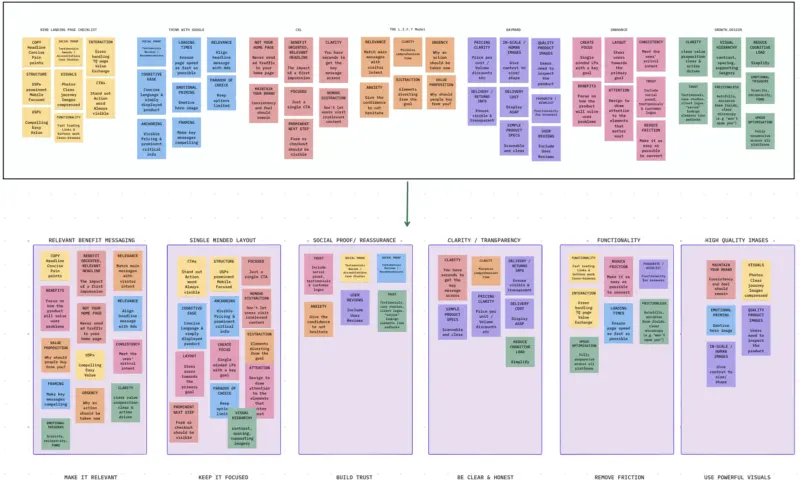
The Six Key Principles of Our Landing Page Framework
1. Make It Relevant
Your landing page should immediately resonate with visitors by aligning with their expectations. If someone clicks through from a social post, ad or email, they should instantly see a message that reinforces why they are there.
- Ensure the headline aligns with visitor intent.
- Focus on benefits that users care about.
- Maintain a consistent message from ads to landing page.
2. Keep It Focused
A cluttered landing page can overwhelm visitors, meaning a reduction in conversions. Keep the layout simple, with a single goal in mind - whether that's a sign-up, purchase, or download. The clearer the user journey, the more likely users are to take action.
- Use a single-minded layout that directs attention to a clear CTA.
- Reduce distractions by removing unnecessary elements.
- Ensure important elements like forms and buttons are prominently displayed.
3. Build Trust
Users need to feel confident in their decision to commit. Including social proof, trust ratings and transparent information (with delivery and returns for example), can reassure them that they’re making the right choice.
- Include social proof, such as testimonials, case studies, and trust badges.
- Display user reviews and other credibility-building elements.
- Reduce user anxiety by reinforcing security and reliability.
4. Be Clear & Honest
People don’t like surprises - especially when it comes to pricing, policies or product/service details. The easier it is to understand what you’re offering, the more likely users are to convert.
- Make key messages clear within seconds.
- Provide transparent pricing, delivery details, and return policies.
- Simplify content to reduce cognitive load.
5. Remove Friction
Every extra step or slow-loading element presents an opportunity for a user to drop off. A smooth and seamless experience makes it easier and more likely for visitors to follow through.
- Ensure fast loading times and smooth navigation.
- Make interactions effortless—easy-to-use forms and clear value exchange.
- Optimise for all devices to maximise usability.
6. Use Powerful Visuals
Strong imagery or videos/animations can make your landing page much more engaging and persuasive. The right image can create emotional connections, relatability, and reinforce messaging.
- Maintain brand consistency through high-quality images and visuals.
- Use in-scale human images to provide context and relatability.
- Apply emotional priming through carefully selected imagery.
Why are landing pages so important?
Landing pages play a huge role in digital marketing because they’re designed with one goal in mind—getting visitors to take action.
Unlike regular website pages, which can have multiple purposes, a landing page focuses on a specific offer, whether it’s capturing leads, driving sign-ups, or making sales.
This makes it a lot easier to keep people engaged and guide them toward the desired next step. As HubSpot puts it, “Landing pages allow you to direct your audience to a specific, relevant offer and capture leads at a much higher rate than a general webpage.”.
They also make for a smoother user experience by keeping things relevant and focused, especially if visitors are coming from a social post, ads, or emails.
They give marketers useful data to see what’s working, test different elements, and improve results over time.
A great example of how effective landing pages can be is our work with UKFT. In November 2023, we launched two new landing pages for their training courses, and the results speak for themselves.
Since then, their average conversion rate has increased by 96%, allowing them to more than double their ad spend while seeing a 150% boost in conversions and a 30% drop in CPA.
By A/B testing different styles, layouts, and form designs, we also helped improve lead quality - something the client has noticed firsthand.
This just goes to show that a well-optimised landing page doesn’t just bring in more conversions, it helps make the most of the marketing budget by improving efficiency and lead quality.
Resources & Further Reading
Our framework is inspired by insights from various industry experts and research studies. Here are some of the key sources we used:
Developing a high-converting landing page requires a structured approach backed by research. Our six guiding principles help ensure that every landing page we assess is optimised for clarity, focus, trust, and performance.
Want to see how your landing page measures up? Use our framework as a checklist, or reach out for a personalised assessment.

About the author
Ellie Langan
Hiya, I’m Ellie! I’m a Junior Creative Strategist at Bind, and I love coming up with ideas and finding creative ways to solve a problem. I love creating work that’s fun, engaging and right for the audience, while my background in Conversion Optimisation helps me make sure your ads and landing pages work together too!
🎵 Favourite Artist: I LOVE a bit of Ariana Grande!
🎉 Hobby: Going on adventures with my puppy and husband, and cosying up under a blanket to watch a bit of Netflix!


