
By Harry Butcher
29 Sept 2026 · 7 Min Read
Last week, we packed out Microsoft's Paddington office with senior B2B marketing leaders for a closed-door morning with Microsoft Advertising and LinkedIn. It was the first time the two have shared a stage in the UK, which felt fitting for a morning about how buyers now find, judge and choose brands.
The morning was broken up into three short talks and three roundtables, and finished off with a Q&A panel. What came out of it was surprisingly consistent. For all the talk of AI rewriting the buying journey, the room kept landing on the same very human instinct.
Here are the six biggest takeaways from us:
TL;DR
- Buyers use AI constantly but don't trust it. Being able to defend a decision beats confidence it'll work, and proof beats polish.
- Up to 10 people sit on a buying committee now, and 40% of deals are lost to indecision. Market to the whole room, not just the CEO.
- Better data tells you what each of them cares about. Clay finds the signals, and LinkedIn and Microsoft let you act on them compliantly.
- Chase better buyers, not more of them. AI is shifting marketing from attention to reputation, and LinkedIn is one of the sources AI trusts most.
- The content AI cites is expert-led, original, fresh and well structured. Paid amplification powers the loop, and Clarity helps close it.
- The tools are new, but the jobs to be done aren't. Build AI literacy, set ground rules and keep human judgement in the loop.
1. Fear of messing up (FOMU) beats fear of missing out (FOMO).
Elliot Sheen, our Co-founder & CEO, opened with a paradox. 90% of B2B buyers now use AI to research, evaluate and shortlist vendors (LIONS/WARC/LinkedIn Buyability report). Yet 94% of those who use it fact-check what it tells them (TrustRadius, 2026 B2B Buying Disconnect Report). We use it constantly. We just don't trust it. At the other extreme sit peer recommendations, closed communities and dark social: trusted, and almost entirely untraceable.
Both are exactly where attribution was never built to reach. Elliot's analogy was "music was better in the 70s". It wasn't… we just only remember the hits. Attribution works the same way, replaying the touchpoints built to be tracked, while consent requirements and cookie deprecation shrink the picture a little more every year.
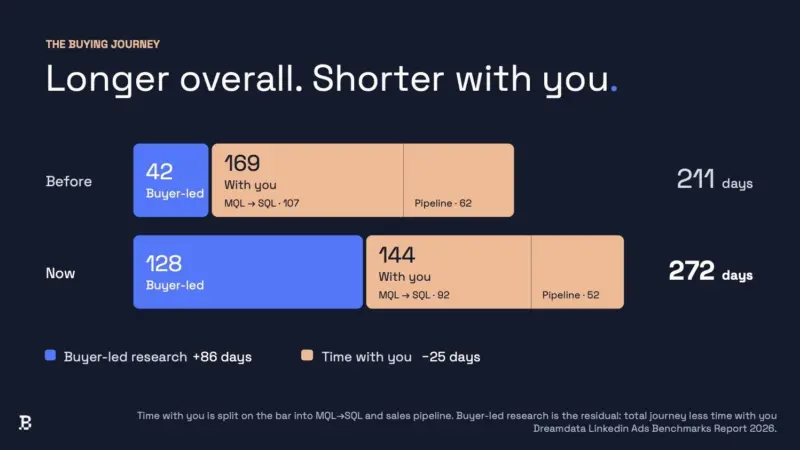
Meanwhile, the journey is getting longer. Dreamdata's 2026 LinkedIn Ads Benchmarks Report puts it at 272 days, up from 211. Buyer-led research has tripled from 42 to 128 days, while time spent with vendors has fallen by 25. That's harder to track, but it's also 128 days where your creative can do the work instead of a salesperson.
What wins in that window is proof. Across the 700 B2B campaigns in the Buyability report, 64% of the top performers were built on customer testimonials, against 16% of the rest. Research from LinkedIn and Bain found the top reason buyers felt extremely confident in a choice was being able to defend it if it went wrong (34%). That just edged out believing it would do the job (33%). No one ever got fired for buying IBM. New numbers, same old instinct.
2. The solo decision maker is a myth.
Madie Hubschmid, our Paid Media Director, picked up the thread with who's actually doing the buying. The old playbook of selling to the C-suite and waiting for the decision to trickle down is gone. Dreamdata puts up to 10 people in the average buying committee, each with their own definition of risk. That helps explain why 40% of B2B deals are lost to indecision rather than to a competitor (LinkedIn, The Credibility Code).
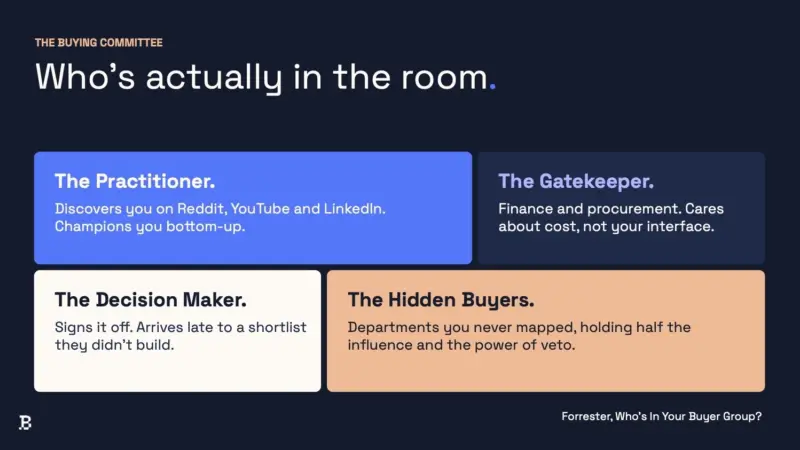
Madie walked through four of the roles that Forrester identifies:
- The practitioner, who discovers you on Reddit, YouTube and LinkedIn and champions you bottom-up.
- The gatekeeper in finance or procurement, who cares about cost, not your interface.
- The decision maker, who arrives late to a shortlist they didn't build.
- The hidden buyers, in departments you never mapped, holding real influence and a veto.
Most of them start without you. Analysis of 555,973 opinions from UK B2B leaders, via The Drum, found 67% say discovery now starts in AI search tools, with ChatGPT the most cited at 42%.
So credibility has to be in place before buyers arrive, and it has to reach the whole group. LinkedIn's Credibility Code research found 9 in 10 decision makers are more receptive to outreach after strong thought leadership. Brands known by the whole buying group are 20x more likely to be bought than those known only by the deal champion.
3. Better data, deployed compliantly.
So how do you reach ten people with ten different worries on a finite budget? With better data.
Madie showed how we use Clay, both for our own marketing and for our clients. For those not familiar with Clay… rather than one database, it runs a waterfall of data providers, trying each in turn until one fills the gap, while its AI agent reads the open web for signals no database holds: job ads, careers pages, funding news and new senior hires. Put those together and you can see which companies are moving in and out of market, and why. It's pay-as-you-go, so you can test first, and the enriched data can flow straight back into your CRM.
Those signals shape the messaging for each persona:
- A new senior hire points to ROI-led case studies for the decision maker
- The current tech stack points to integration messaging for the influencer
- A pile of open roles can signal pain for the users
Whilst this sounds fantastic, we still have compliance at the front of it all. Uploading scraped personal emails to ad platforms is all over LinkedIn right now. But if you follow GDPR to the letter, it isn't compliant, and the responsibility sits with you, not the tool. Company lists on LinkedIn, however, are compliant by default, because you're targeting accounts, not people. Microsoft is starting to bring LinkedIn firmographic targeting into Search as bid adjustments, and company lists are arriving, though the process is still manual. Once that matures, Clay's account intelligence, LinkedIn's professional data and Microsoft's search intent become one buying-group strategy.
Targeting gets you in front of the buying group. Being buyable is what lets them agree. Madie closed with the three Rs from the Buyability report: recommendations from peers and experts, relationships built before the search starts, and relatability, meaning proof from customers who look like them. Relationships matter most early, with 81% of buyers already knowing the winning brand at the start. Yet the average campaign carries just 1.6 of the 7 buyability signals, and those strong on them are 1.62x more likely to lift ROI and 2.09x more likely to grow revenue.
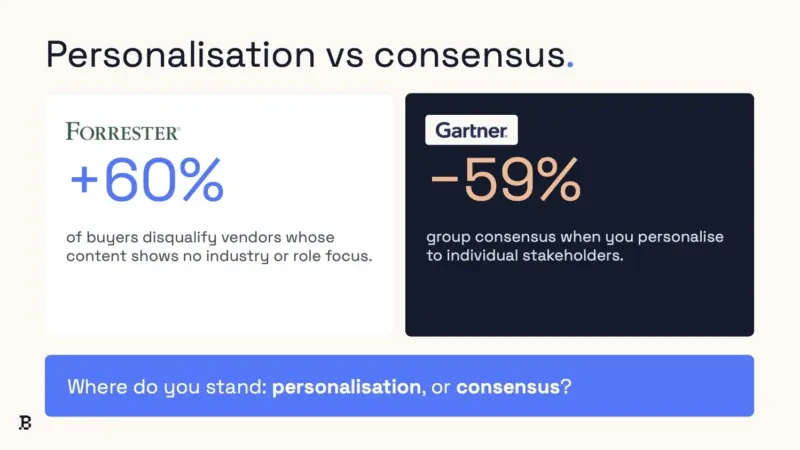
That set up the first roundtable question. Forrester says over 60% of buyers disqualify vendors whose content shows no industry or role focus, while Gartner finds personalising to individual stakeholders cuts group consensus by 59%. So which is it, personalisation or consensus? The tables didn't settle it, and we're not convinced there's one right answer.
4. Better buyers, not more buyers.
Tina Aird, Growth Advertising Director at Microsoft Advertising, pushed back on the instinct to chase reach. More people doesn't automatically mean more growth. The question is whether you're reaching buyers with the right intent and buying power. As she put it, Microsoft understands what people are researching, and LinkedIn understands what they're looking for professionally. According to GWI, Microsoft audiences are 34% more likely to be senior decision makers.
Tina framed the change as three eras of the web running at once:
- The human web: "help me find it".
- The LLM web: "help me choose".
- The agentic web: "do it for me".
The human web still pays the bills. But automated traffic is growing 8x faster than human traffic (HUMAN Security), so the job now is making sure AI is telling your story.
Josh Hall, Agency Development Lead at LinkedIn, showed why that matters. 83% of AI-assisted searches end without a click (Similarweb), and 94% of buying groups use ChatGPT, Gemini or other LLMs before talking to sales (6sense).
Marketing is shifting from attention, meaning what a brand says about itself, to reputation, meaning what the marketplace says about it. LLMs lean heavily on trusted, verified sources. Meltwater's 2026 study found LinkedIn is the second most cited domain across major AI search platforms, with citations growing 26% during the study. It's also the most cited source for professional queries.
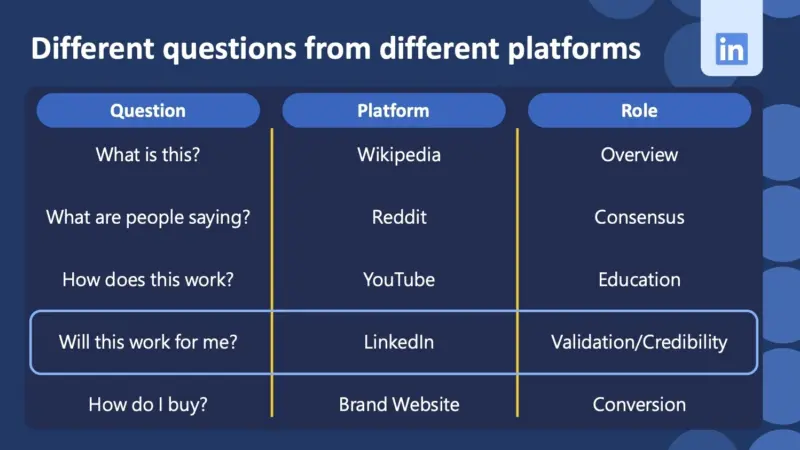
Josh's neat summary of who answers what: Wikipedia covers "what is this?", Reddit "what are people saying?", YouTube "how does it work?" and LinkedIn "will this work for me?"
5. Make your expertise citable, then close the loop.
Talk three got practical. Josh shared what AI actually cites from LinkedIn (all Meltwater data):
- 75% of LinkedIn citations come from individuals rather than company pages.
- Long-form articles earn 6.5x more citations than standard posts.
- 72% of cited content is original, and 48% was published in the last three months.
- Every top-cited article used lists, and 92% used clear headings.
The recommended target is articles of 800 to 1,200 words and posts of 200 to 300.
Paid doesn't buy citations, but it powers the loop that earns them. Test organically, spot the posts drawing quality comments, then amplify them, particularly through Thought Leader Ads from your execs and experts. As Josh admitted, much of this is just good SEO, spread across more platforms.
Lucy Spain from Microsoft Advertising then introduced Clarity, Microsoft's free behaviour analytics tool. It connects Microsoft and Google ad spend to what people actually do on your site, so you can tell a media problem from a slow page or an unclear message. Its new AI visibility reports show which AI crawlers reach your site, where your pages are being cited, and where competitors are winning topics you aren't. Also worth watching, though still in pilot, is Copilot audience generation, which builds targeting from a plain-language description of your buyer.
6. The jobs to be done haven't changed.
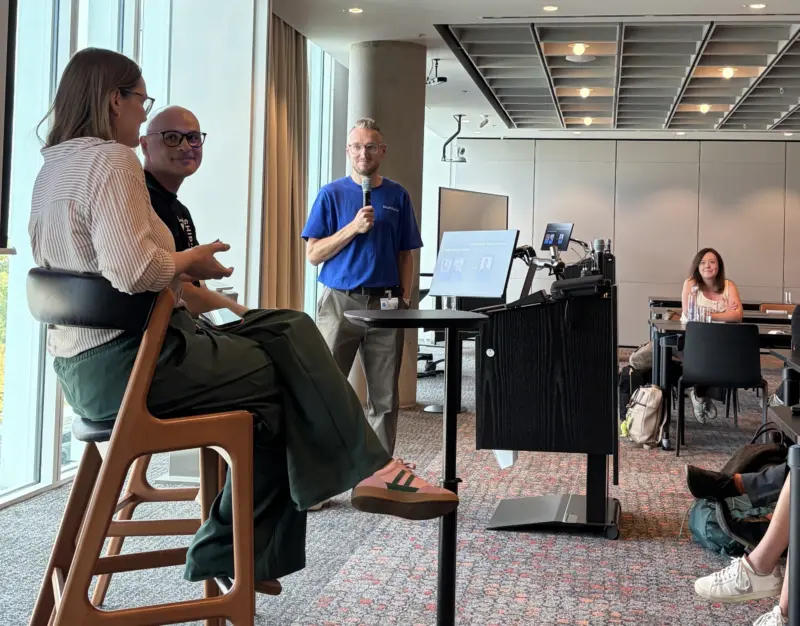
Finally, we closed with a panel hosted by Ryan Webb, our Head of Partnerships, with Veronika Prophet, Marketing Director at Corsearch, and Fatih Mehtap, VP Marketing, ex-DigitalOcean.
The main topic was ‘Marketing leaders share their top priorities and challenges for 2027’, but we think we got a lot more than that.
Veronika's biggest challenge was capacity, and not in the "give us more people" sense. "It's not just doing more, it's where do we put our eggs."
Fatih's was organic search. "Our [DigitalOcean] organic traffic just got decimated in the last three, four months." LLM traffic is climbing, but not fast enough to make up the difference, so diversification became the job. "The things that got us here are not going to take us forward." One bet that paid off was YouTube's creator programme. It started as a small pilot bringing in one or two conversions a day, then doubled, and doubled again, once budget was moved across.
On AI, both came back to fundamentals. "The jobs to be done have not changed," said Fatih. Leaders can't just "swan in and say everybody needs to start using AI" without building literacy first, and teams need ground rules and discernment.
Veronika treats AI as a starting point, not a finished product. "It's so much easier to start with something to edit than to stare at a blank screen."
On channels, Veronika has found Google Search works as a bottom-of-funnel demo driver, while LinkedIn builds audiences at the top. Fatih's advice to the room: "Work backwards from your goal. Don't spread yourself too thin."
The thread running through it all
AI has changed where buyers look. It hasn't changed why they buy. They still want to feel safe, still trust people over pitch decks, and still need the whole group on side. The brands that win will be findable by the systems and credible to the humans.
Thank you to Tina, Lucy and Josh, to Veronika and Fatih, and to everyone who gave up a morning to join us.
Want to put some of this into practice? Book a Clay demo with Ryan and register your interest for our next event using the form below.