
![Pinterest Ads: Guide to ad specifications (with examples) [2025]](https://bind.lon1.cdn.digitaloceanspaces.com/images/Headshots/_120xAUTO_crop_center-center_none/3544/Will.webp)
By Will Jeffrey
15 Mar 2024 · 11 Min Read
While sometimes (unfairly) overlooked in favour of other social media platforms, did you know Pinterest is actually used by a whopping 518 million people per month?
Not only that, but those ‘pinners’ are actually more likely to shop than those on other platforms. Unlike typical social media sites, the purpose of Pinterest lies in seeking out products to buy or collating a mood board that serves as the basis for interior decor or a new outfit.
As a result, Pinterest ads offer a 2X higher return on ad spend for retail brands compared to other social media platforms, which is certainly not to be scoffed at. The site’s appeal is mostly visual, with a focus by users on creating a lifestyle or design aesthetic that they’d like to mimic in their real lives.
Consequently, the importance of creating visually appealing ads for Pinterest can’t be overstated. As well as catchy slogans, visuals should be front and centre of your ad campaign, with an aesthetic that rivals the rest of the user’s feed. In short, your Pinterest ads have to be as eye-catching as possible.
The good news? We’re here to help. In this blog post, we’ll explore Pinterest’s ad specifications as well as exploring examples of Pinterest ads done right. Let’s get into it.
Pinterest ad specifications.
Before posting on Pinterest, you’ll need an idea of the size and quality of your assets. Here are Pinterest’s ad specs.
Image dimensions.
File type .PNG or .JPEG
Max. file size Desktop 20 MB, in-app 32 MB
Aspect ratio The best option is a 2:3 aspect ratio, or 1000x1500 pixels. Pins with an aspect ratio greater than 2:3 can get cut off in people's feeds.
Aim to use high-quality vertical images that will stand out on users’ feeds. Colour is a big consideration - whether you choose to go for eye-catching pastels or a sleek black-and-white option, it should be different enough to draw the eye away from the rest of the visual feed.
Video specifications.
File type .MP4, .MOV or .M4V
Encoding H.264 or H.265
Max. file size Up to 2 GB. Minimum length 4 seconds, maximum length 15 seconds.
Aspect ratio Shorter than 1:2 (width: height), taller than 1.91:1. Pinterest recommends making your videos square (1:1) or vertical (2:3, 4:5, or 9:16).
With video content on the up (there’s a reason why TikTok is so popular!), consider adding video ads to your Pinterest repertoire.
Pinterest allows you to choose from standard or max-width video ads, with the latter expanding across people’s entire feeds on mobile. These ads are only available in a paid format and have the same specs as the standard videos, with the exception that they can’t exceed the height of a 1:1 aspect ratio. You can also reserve a premium placement using Premiere Spotlight.
When creating video content, Pinterest recommends your videos be longer than 6 seconds (without exceeding the maximum of 15) to allow you ample time to get your point across. Once the video is over, you’ll want consumers to remember your name and logo, so remember to keep your branding front and centre.
The adage ‘show don’t tell’ comes in handy here, too. Many Pinterest scrollers will see your ads with their sound off, so don’t rely on audio to tell your story - create visual content that speaks for itself.
Text and descriptions.
These character counts are the same for both image-based ads and video ads.
Title Enter up to 100 characters. Depending on the device, the first 40 characters may be visible in people’s feeds. When entered, titles will appear in the home feed or search feed. If no title is entered and no Rich Pin title exists, nothing will be visible in its place.
Description Enter up to 800 characters. Descriptions do not appear when viewing the ad in the home feed, search feed or up close. Descriptions are used by our algorithm to determine relevance for delivery. We recommend entering a description to help get your ad in front of the right audience.
Remember, when it comes to copy, you only have a few lines to impress your target audience. Keep it concise and snappy - don’t make consumers have to work too hard to figure out what you’re about.
Call-to-action (CTA) buttons.
The best way to include a call to action in your Pinterest ad (aside from naturally including one in the description) is through direct links. While only available on standard image and video ads, direct links in Pinterest ads take users directly to your site, rather than providing a close-up, when a user clicks on your ad. Ads with a direct link will also contain a CTA beneath the ad creative that encourages users to take action, improving conversions and traffic on your site. You can see an example of direct links in use by jewellery brand, Pandora, below.
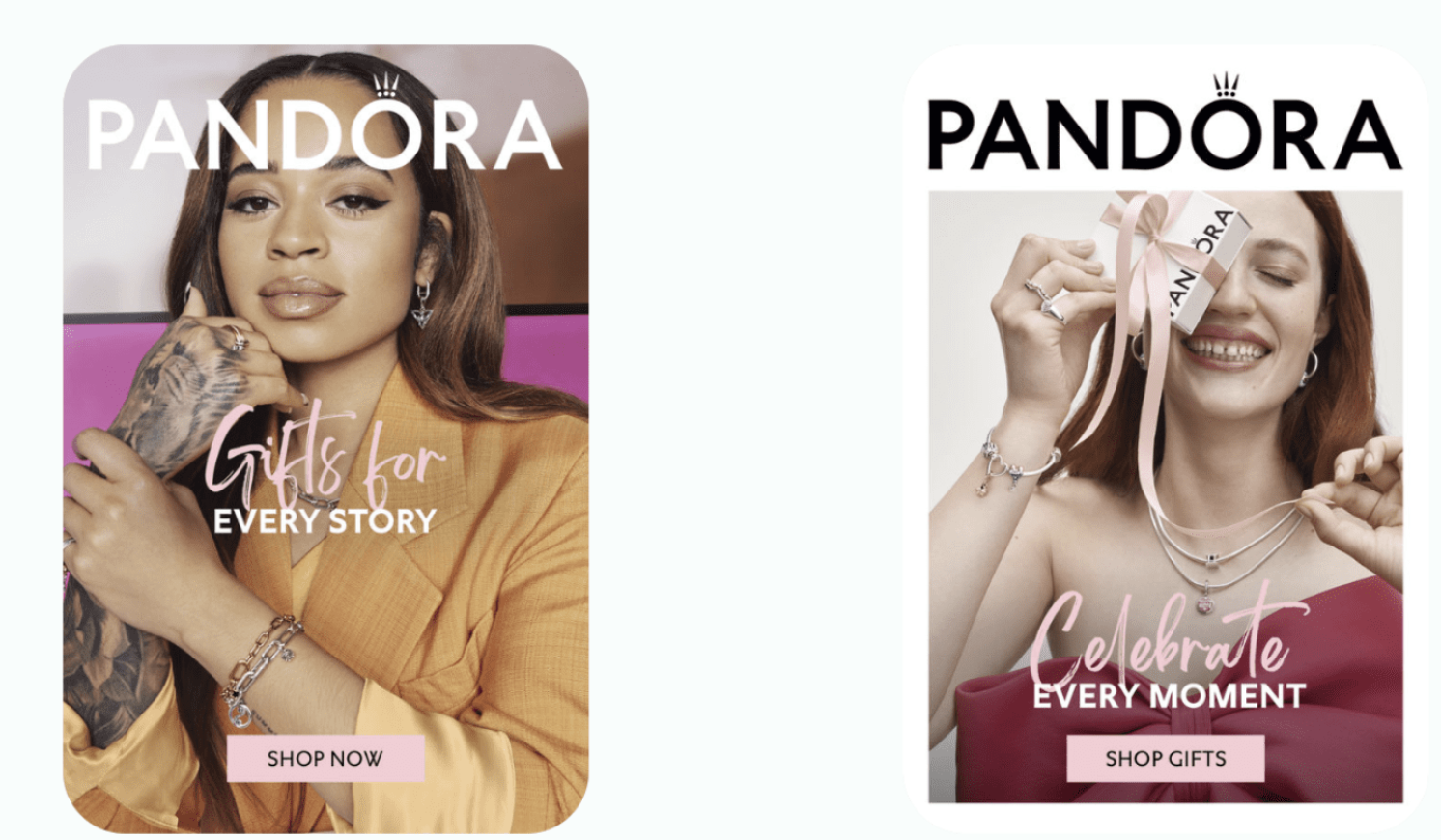
Otherwise, you can simply include a call to action in your copy. Your call to action should be straight to the point, convincing, and can even be playful. ‘Shop our new collection’ can become ‘Unlock your new style’ - focus on selling the benefits not the features of your products when making your sales pitch.
Pinterest ad examples.
The best way to get an idea of what does and doesn’t work is to explore some of the most successful Pinterest ads. Let’s take a look at what they do right, and what you could potentially do to make yours even better.
Promoted pins.
Promoted pin ads are the standard ad campaign for Pinterest, placing pins in the feed organically. They’re ideal when you’ve got a simple message that can be captured in an image and provide the perfect canvas for using Pinterest’s trend data and automation to boost conversions.
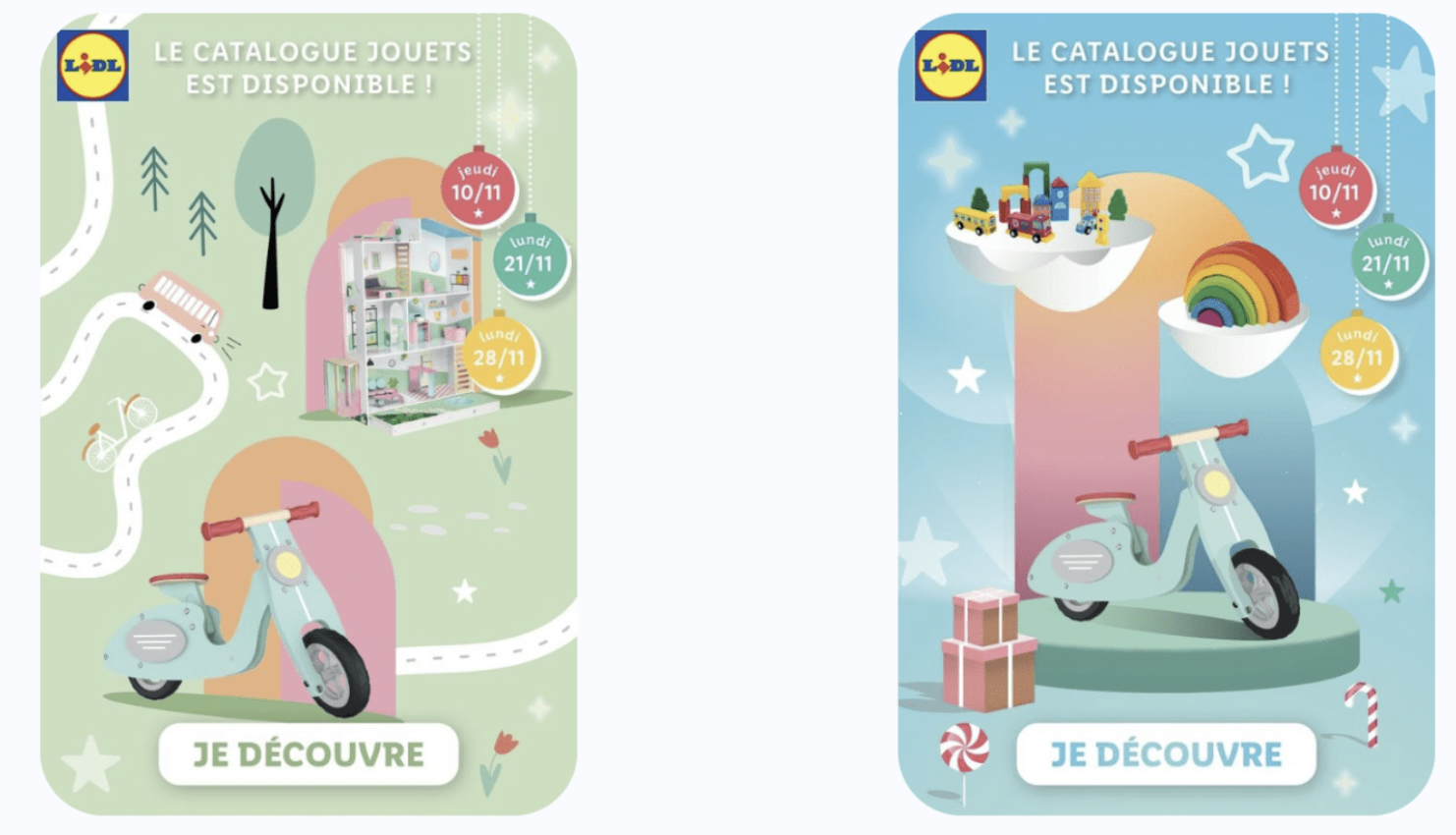
This campaign from Lidl, for example, not only showcases bright eye-catching images, but also makes the most of the Pinterest Trends tool to identify the top toy-related search terms in France and tie its ads to trending topics. Likewise, the brand leveraged outbound click optimisation for its campaign, boosting traffic to its site. Overall, it managed an impressive 87% reach. Here are some examples from the multi-objective campaign:
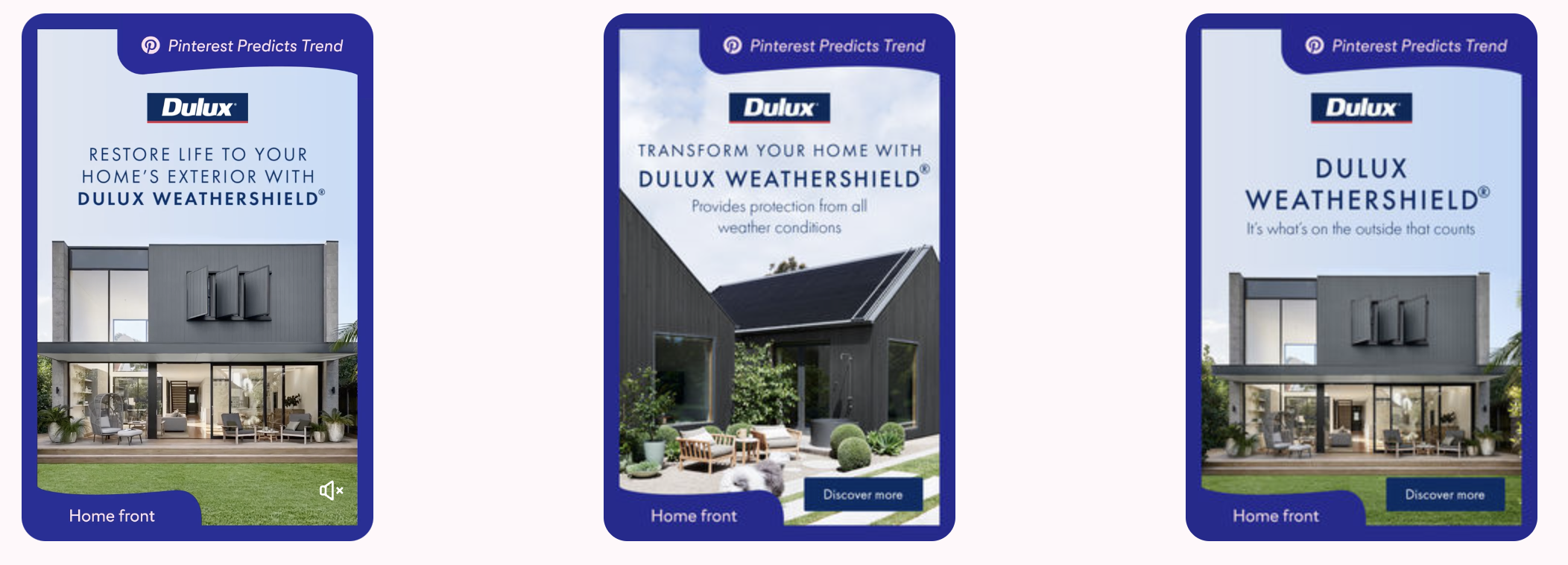
Another example of a brand making the most of Pinterest Trends was Dulux’s campaign. Pinterest data showed that homeowners are increasingly concerned with their homes' first impression, so Dulux capitalised on the trend by basing its ad campaign on the home’s exterior.
As a way to A/B test, Dulux crafted ads both with and without the distinctive border. The distinctive border came up top, with a 3.2-point boost in brand awareness. You can see examples of the Dulux approach below.
Carousel ads.
Carousel ads, ads including multiple images in a carousel format, are perfect for brands wanting to show off a new collection or tell a story that can’t quite be captured in just one image or video.
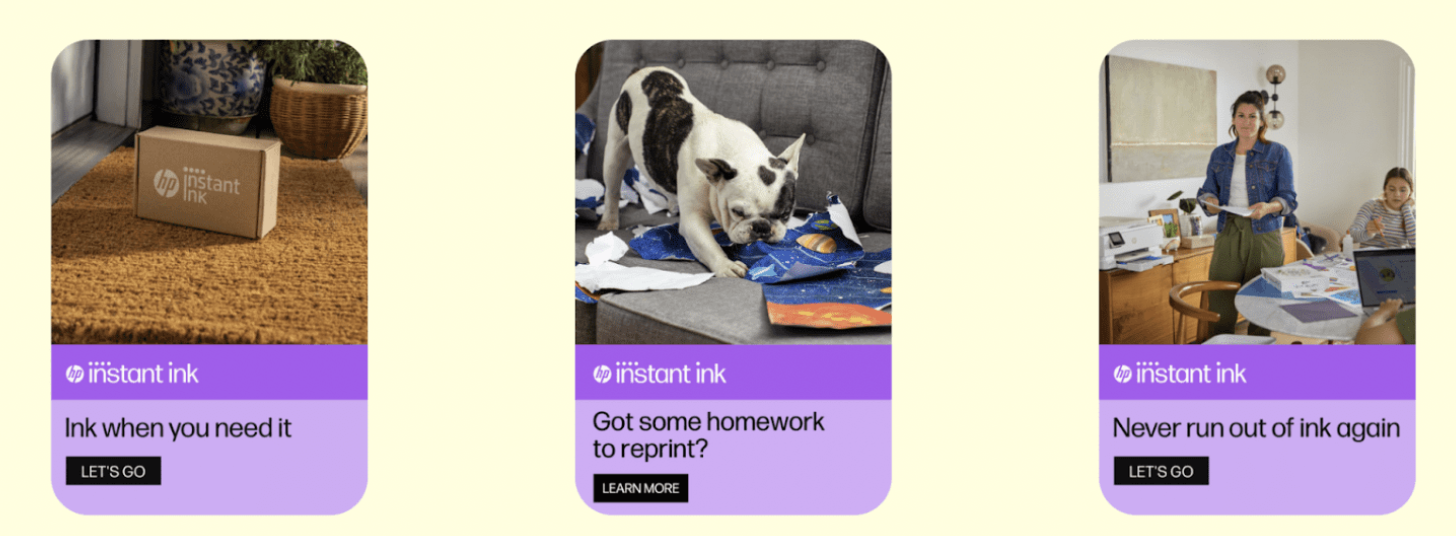
HP took a multi-faceted approach, including static, video, and carousel ads in its campaign for maximum success. This is certainly something your brand can try if you believe you’ll benefit from multiple formats. Part of the power of these ads (as seen below) is their simplicity. One straightforward image paired with a simple line of copy with a bold background.
The playful ‘Let’s Go’ call to action gets straight to the point. With just one image, one description, and one CTA, consumers immediately know what the brand’s all about and what they can expect if they click on a link.
Video ads.
As shown by the popularity of TikTok and Instagram Reels, video is king in the new world of content. Video content works you’re promoting a product where visual is everything or you have a story to tell that can’t be communicated via image only.
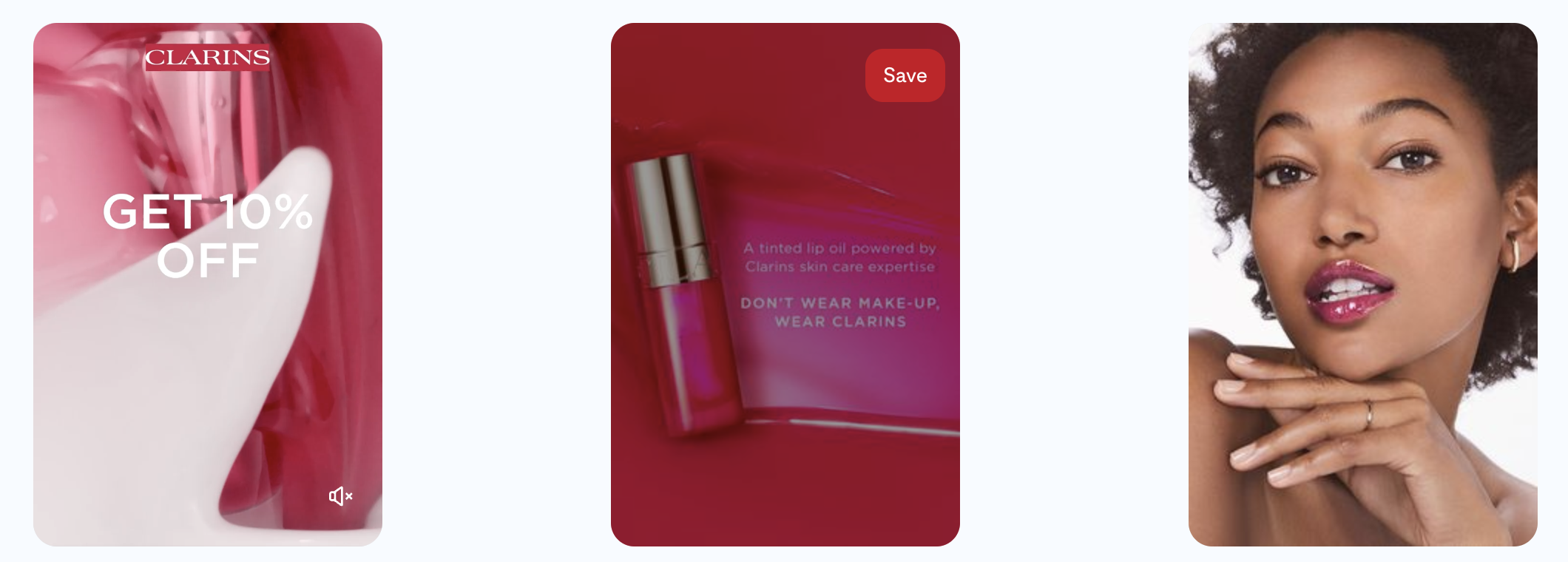
Beauty brand, Clarins, had a bumper campaign featuring the power of video, which resulted in a 2.5X lift in action intent, and 12X conversion. As you’d expect from a beauty brand, visuals are everything, so Clarins tapped into the trend of video content to produce eye-catching creatives that showed the power of its lip oils through moving images.
The concise, image-based visuals kept text to a minimum, using copy only to introduce the product and boost brand awareness. For brands in the healthcare and beauty industry, using visuals to prove results is a must. Check out some stills from the campaign below.
Shopping ads.
Shopping ads provide users with a seamless shopping experience, allowing customers to purchase products quickly without having to leave the Pinterest app. This convenience means your audience can check out in just a few clicks after seeing your ad, making it the perfect ad format when conversion is your key objective.
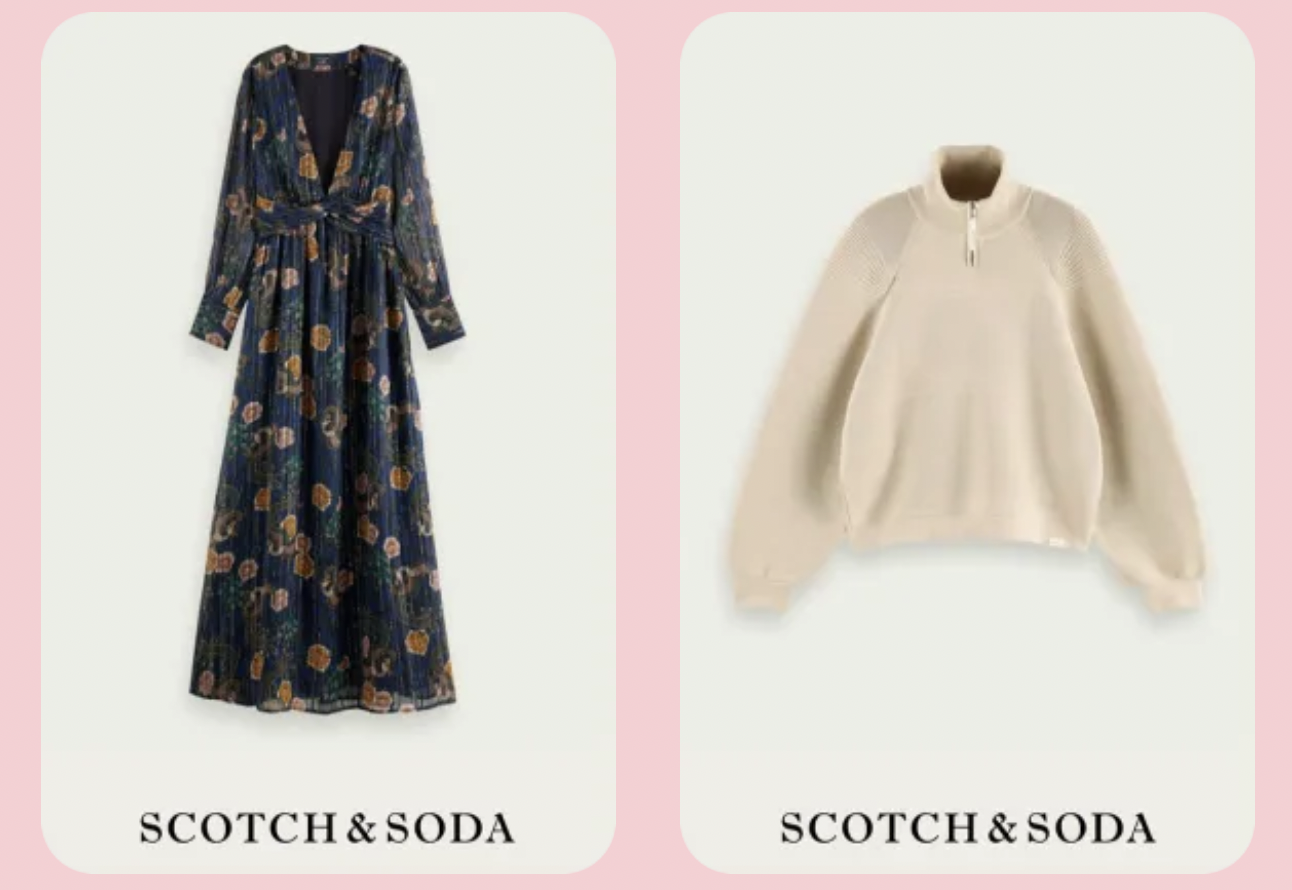
This is a game-changer for advertisers since removing friction from the checkout process is one of the main converting factors. Boasting a 7X ROAS than with previous campaigns as well as reaching 800,000 unique users and more than 500 add-to-carts, clothing brand Scotch & Soda enjoyed success with Pinterest shopping ads. Since fashion is such a key draw on Pinterest, this platform was the perfect place for Scotch & Soda to promote its products.
In terms of creative, Scotch & Soda kept it as simple as possible and let the clothes do the talking, with only the brand name included in the ad as a way to boost brand awareness. High-quality product images were key to this ad format’s success, so remember to put product photography at the heart of your campaigns. Take a look below for inspiration.
Collection Ads
Collection Ads combine a hero creative, either an image or a video, with a row of smaller product images pulled directly from your catalogue. This creates a more immersive, shoppable experience within the feed.
They're best for lifestyle-led creative that shows products in context. For example, a homeware brand could feature a styled living room as the hero image, with product cards underneath linking to the individual sofa, coffee table and lamp.
Specs:
- Hero creative: static image (JPEG/PNG up to 10MB) or video (MP4/MOV up to 2GB, 4 sec–15 min).
- Secondary creatives: minimum 3, maximum 24 product images.
- Aspect ratio: 1:1 or 2:3 for hero; 1:1 recommended for product cards.
Idea Ads (formerly Story Pins)
Idea Ads are multi-page, full-screen ads that let you combine images, short videos, text overlays, stickers and links into one cohesive experience. Best for tutorials, recipes, DIY guides or brand storytelling. A fashion retailer, for instance, could create a step-by-step “How to style a summer look” ad, with each frame highlighting a different outfit piece.
Specs:
- Up to 20 frames per ad.
- Vertical 9:16 format (1080×1920 px).
- Supports mixed media (images, video, text, stickers, links).
- Title up to 100 characters; on-frame text up to 250 characters.
Showcase Ads
Showcase Ads are a swipeable format that starts with a main title card, followed by up to four feature cards. Each card can include interactive overlays, giving advertisers more space to highlight multiple products or messages.
Best for highlighting seasonal collections, new launches or product features within a single campaign. A beauty brand, for example, could spotlight four skincare products, with overlays detailing key benefits like hydration or SPF protection.
Specs:
- Title card + up to 4 swipeable feature cards.
- Images: JPEG/PNG up to 32MB, 2:3 ratio recommended.
- Videos: MP4/MOV, 3–60 seconds.
- Overlay text: keep under 10 words per card.
Quiz Ads
Quiz Ads bring an interactive, question-led format to Pinterest. They start with a title card, include up to three multiple-choice questions, and finish with a personalised results card.
Best for driving engagement and guiding users to the right product. For example, a skincare brand could ask about skin type and goals, then serve tailored product recommendations at the end of the quiz.
Specs:
- Flow: title card → up to 3 question cards → results card.
- Supports static images (JPEG/PNG) or video (MP4/MOV, 3–60 sec).
- Question length: up to 96 characters; answers up to 48 characters.
- Results card title: up to 100 characters; description: up to 500 characters.
Tips for success.
Convinced that Pinterest ads are worth it, but simply not sure where to start? Here are some best practices to put you on the path to Pinterest success.
Consistency in branding.
When it comes to online ads, your brand is everything. While shoppers might not want your particular product in the moment they see your ad, make enough of an impression and you’ll become their first thought the next time they are in the market for it.
Consistency, both in visuals and tone of voice, is key to creating a cohesive brand image. To start, choose a tone of voice for your brand and stick to it. When it comes to visuals, use the same colour palette and styling - switching from avant-garde pastels to traditional black and white between ads will confuse consumers. Having strong brand guidelines that your team and any external supporters follow will help to streamline your brand identity.
Making the most of Pinterest’s features.
It’s in Pinterest’s interest to keep you posting ads, so it’ll work as hard as possible to get you seen by the right people. Make the most of Pinterest’s tools to get the results you want by uploading your customer list, using actalike audiences, and targeting specific search terms.
With analytics to dive into, you can track your performance based on your desired outcome and adjust as necessary. If you suspect the copy, visuals, or type of ad isn’t working, adjust until you get the results you want. For a full list of the tools and automation at your fingertips when you use Pinterest ads, visit the official site.
A/B testing.
A/B testing, AKA running two ads to see which achieves the better outcome, is a great idea on visual-based Pinterest. One method of successfully establishing which version of the ad will work best can be to change just one element.
If you change the text and the image, for example, you won’t know whether the success of an ad is due to the visuals or copy. It can be more effective to choose one element and adjust it, testing which tone of voice or which colour palette is the most effective, for example.
If you’re not looking to compare either just the visuals or copy, though, and you’re competing between two ads as a whole, putting up two completely different ads might be your preferred method.
Pinterest Ads: Your next campaign’s secret weapon.
With an ever-growing customer base and almost half of its user base having an income of $100k+, there’s never been a better time to start advertising on Pinterest.
Whether you're new to advertising on Pinterest, or perhaps your existing activity isn't delivering the desired results, our expert team is on hand to support you with everything from creative strategy to paid media management. Don’t just take our word for it - we’ve got the awards to back up our credentials.
Interested in seeing how paid media can revolutionise your business’ success? Get in touch today!