

By Isabella Doyle
21 Apr 2026 · 8 Min Read
The death of generic targeting.
The brands scaling profitably in 2026 aren't spending more- they're spending smarter, by identifying the 20% of customers who drive 80% of their profit and using them as the foundation for growth.
The good news is that this isn't guesswork - there's a clear methodology behind it, grounded in clean data collection, careful analysis, and targeted activation across paid channels. This guide walks you through the full journey: from auditing your data infrastructure, to building high-value customer segments, to scaling what works
The foundation: auditing your data Infrastructure.
Most businesses are collecting some data. Fewer are collecting the right data across all meaningful touchpoints, and fewer still are managing to do so optimally and in full compliance. An honest audit of your analytics and tracking setup tends to surface issues that aren't always obvious, and small gaps at this level have a habit of quietly undermining everything built on top of them. The most common culprits tend to fall into a few clear areas.
Is your consent framework up to scratch?
Central to any audit is consent. A well-configured Consent Management Platform (CMP) ensures user preferences are captured and respected consistently across your tracking stack. For Google advertisers, correct Consent Mode v2 integration allows Google's modelling to recover conversion signals from users who decline tracking, making it as much a performance consideration as a compliance one. We've written about this in more detail here:
- Google Tag Manager consent mode setup with Cookiebot: A practical step-by-step guide to implementing Consent Mode in GTM using Cookiebot.
- Guide: Beyond compliance — how consent affects consumers. A broader perspective on how consent strategy influences trust and conversion behaviour.
- “Accept all” or “Reject all”: does granular cookie consent matter? A practical look at what “compliance” actually means in the real world.
Are your platforms receiving the right signals?
GA4, ad platform pixels, Enhanced Conversions, and the Conversions API (CAPI) all benefit from being reviewed together, each contributing to the richness of the signals your ad platforms receive, and to the precision of the customer segments you can build from them. For businesses ready to go further, server-side tracking, cookieless measurement, and offline conversion imports each add another layer, enabling value-based optimisation, more durable audience building, and a complete view of customer value beyond the browser.
Signal quality and value-based optimisation.
With conversion values that reflect true business worth flowing to your ad platforms, whether via GA4, a server-side pipeline, or offline conversion imports from your CRM, you can move from optimising for conversion volume toward optimising for conversion value. The richer the signals flowing to your platforms, the more precisely your customer segments can be defined, and with tROAS bidding, the more effectively your campaigns can self-optimise toward the most profitable ones.
For e-commerce businesses, server-side Google Tag Manager (sGTM) is worth particular attention. It allows profit margin data to be appended to conversion events server-side, without exposing sensitive pricing information in the browser, meaning your segments and bidding strategy can be built around your most profitable customers, not simply those with the highest gross spend. sGTM also bypasses ad blockers, extends first-party cookie lifespans, and provides a centralised enrichment layer across platforms.
For lead generation businesses, this means assigning value proxies to different lead types. A demo request from a well-matched prospect carries different downstream value than a top-of-funnel content download. If that distinction isn't making its way back to your ad platforms, your bidding strategy is working with an incomplete picture.
Cookieless ping & offline conversion tracking.
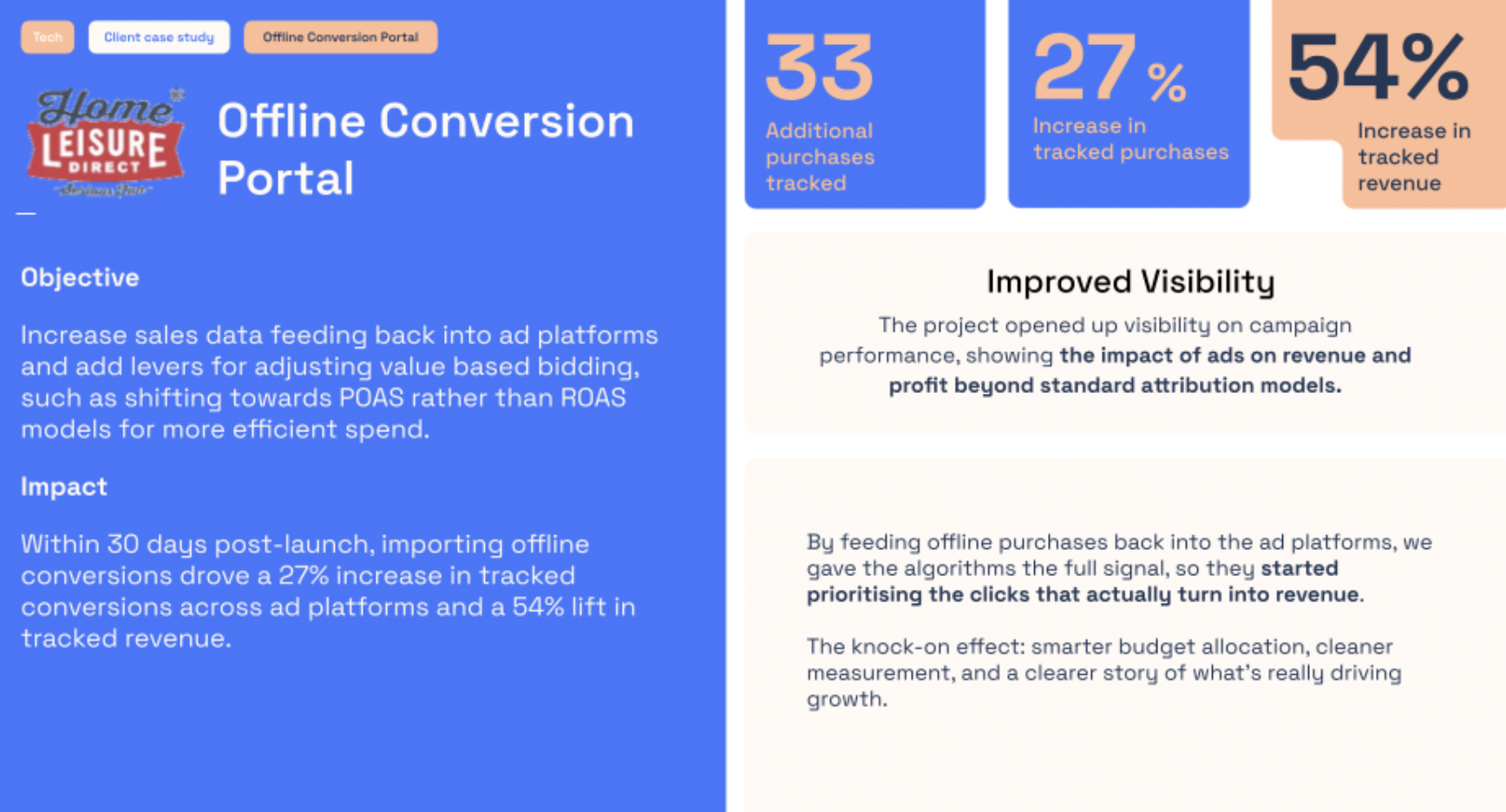
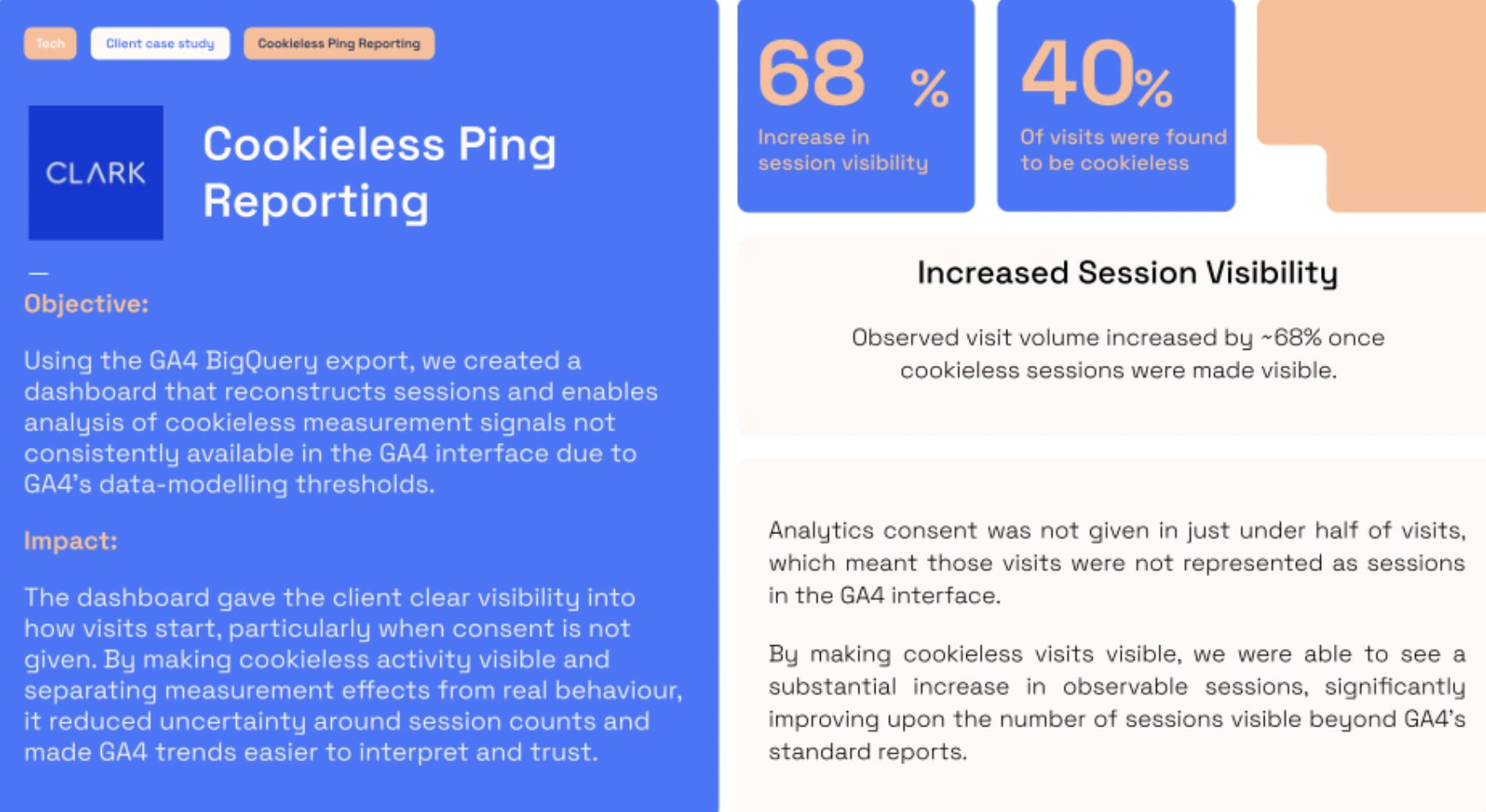
Cookieless tracking adds another dimension, capturing behavioural signals client-side without relying on cookies, and building audience segments that can be uploaded directly to ad platforms. For businesses where valuable conversions happen offline (a phone sale, a CRM opportunity that closes weeks later), offline conversion imports ensure those outcomes feed back into your bidding strategy, rather than creating attribution gaps that undermine your bidding strategy over time.
Identifying your most valuable customers: RFM analysis and predictive LTV.
With clean, compliant data flowing, you can move beyond vanity metrics to the analysis that actually informs growth decisions: who are your most valuable customers, and what do they look like before they convert?
RFM modelling: A proven starting point.
RFM; Recency, Frequency, Monetary value: is a well-established customer segmentation strategy that scores your customer base across three dimensions. Customers who bought recently (Recency), buy often (Frequency), and spend more (Monetary) score highest. The model surfaces your high-value customers and distinguishes them from one-time, discount-driven, or lapsing buyers.
For e-commerce businesses, RFM maps directly to transaction data: last purchase date, number of orders, and total revenue. For lead generation businesses, the translation requires more thought. Recency might be the last engagement date, Frequency could be the number of interactions or touchpoints, and Monetary value maps to deal size, contract value, or estimated LTV from the CRM.
With your customer base ranked and segmented, these tiers become the building blocks for everything downstream. Your top-tier customers become seed audiences for lookalike expansion in ad platforms. Your mid-tier segments become re-engagement targets. Your bottom tier (the one-time, discount-driven buyers) can be suppressed from your highest-value campaigns to keep your bidding signals clean. The segmentation itself isn't the output; it's the input to every targeting, bidding, and creative decision that follows.
Predictive LTV: Finding tomorrow's best customers today.
While RFM tells you who your best customers are today, Predictive Lifetime Value (LTV) modelling tells you who they'll be tomorrow. By analysing early behavioural signals such as acquisition channel, initial engagement patterns, and how quickly a prospect or customer takes their next meaningful action, you can score new users by their predicted long-term value within days of acquisition.
For lead generation businesses, this scoring is most powerful when connected to your CRM. Matching early engagement signals against the profile of your historically highest-value closed deals gives your ad platforms something far more meaningful than a raw form submission.
For e-commerce brands, the difference in long-term customer value can be stark. A customer who enters through a high-margin product category and makes a second purchase within 30 days will typically be far more valuable long-term than one acquired through a discount code who doesn't return. Treating both with the same CPA target means your bidding strategy is working against your margins.
This is where the conversion values established in your tracking infrastructure come into their own. Passing signals that reflect true business value — margin, predicted LTV, or lead quality- back to your ad platforms gives Smart Bidding a far more accurate picture of what a conversion is actually worth.
Scaling the winners: Turning segments into performance.
With your segments defined and your data infrastructure in good shape, the final step is activation. The question shifts from who your best customers are to how you find more of them efficiently and at scale.
Building and deploying your segments.
GA4's audience builder allows you to create segments based on behavioural conditions: users who completed high-margin purchases, users who have made three or more transactions, users who visited specific high-intent pages. For lead generation businesses, the same logic applies- users who visited key service pages, completed high-value form types, or match the behavioural profile of your best closed deals. These audiences can be exported directly to ad platforms for search remarketing, Customer Match uploads, or as seeds for lookalike modelling.
Equally important is identifying who not to target. Customers who only convert during sale periods, churn immediately afterwards, and show low predicted LTV tend to dilute bidding signals and inflate reported ROAS without contributing meaningful business value. Segmenting and suppressing these audiences from your highest-value campaigns is a quick performance win.
Customer match and lookalike audiences.
While GA4 audiences are built from observed on-site behaviour, Customer Match takes a different approach- your first-party data, such as email addresses and phone numbers, is uploaded directly to ad platforms, independent of website activity. Used this way, high-value customer lists enable both direct re-engagement and, more importantly, serve as the seed for algorithmic lookalike expansion.
The quality of your seed list shapes the quality of your lookalike. A list built from your top customers by LTV will generate a meaningfully different expansion audience than a broad all-customers export- and being deliberate about what you're asking the algorithm to replicate is one of the more underutilised levers in paid media.
Churn prediction: Proactive retention.
Activation isn't only about finding more of your best customers. It's also about keeping the ones you have. For both e-commerce and lead-gen businesses, identifying at-risk customers before they disengage is considerably more cost-effective than winning them back afterwards. Churn indicators vary by business model: for subscription or repeat-purchase ecommerce, declining purchase frequency and increasing time since last order are meaningful signals. For lead gen, declining engagement with sales communications or reduced product usage data from your CRM are worth monitoring.
Where churn prediction exists in your CRM, those signals can often be connected back to your ad platforms through audience imports or an offline conversion pipeline. Done effectively, it means re-engagement activity is timely and relevant, reaching the right customers with the right message at a point when it's still likely to make a difference.
The segmentation flywheel.
Customer segmentation strategy is not a one-time project. As your customer base evolves, your segments need to evolve with it. A quarterly review cadence to refresh RFM scores, update LTV models with new cohort data and audit GA4 audience quality helps ensure your targeting stays grounded in current behaviour rather than historical assumptions.
The brands that scale well over time tend to treat their data infrastructure and segmentation methodology as something that gets more valuable the longer they invest in it. The flywheel, when it's working, looks like this: better data produces better segments, better segments improve bidding signals, better bidding signals attract more valuable customers, and more valuable customers generate better data. Each iteration sharpens the one that follows.
Where to start.
If this methodology feels like a significant undertaking, the most practical first step is an honest assessment of your current data infrastructure. Before segmentation, before LTV modelling, before value-based bidding- it's worth understanding whether your data is accurate, compliant, and complete enough to build upon.
Bind Media's Analytics Health Check is designed to answer that question. We look at your GA4 implementation, consent architecture, sGTM setup, and conversion data quality, and provide a clear, prioritised view of what's working, what isn't, and what to address as a priority. Get in touch to find out more.
From there, the journey from guesswork to growth is methodical, not magical.